
Random Number Generator 1 5
Need a quick, fair pick between 1 and 5 — to choose one of five options, decide who goes first or run a classroom activity? Press the button for a random number from 1 to 5. You can also generate many at once, with or without repeats, and watch the tally build up to see that every number really does come up about equally often.
- Free to use
- No sign-up
- Runs in your browser
Random number 1–5
Probability Classroom Pack
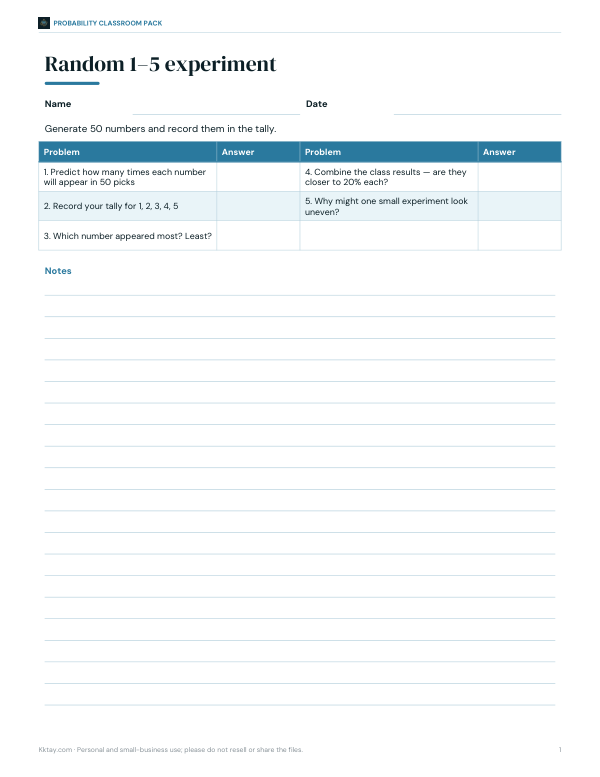
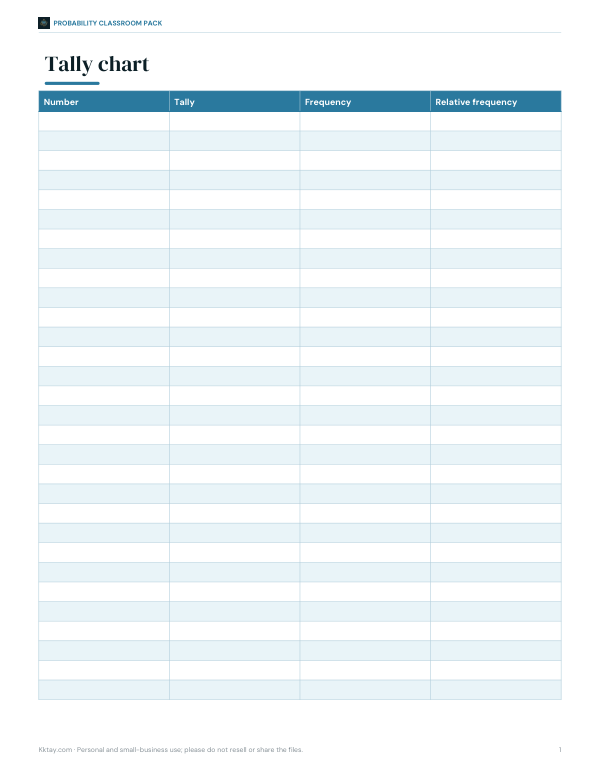
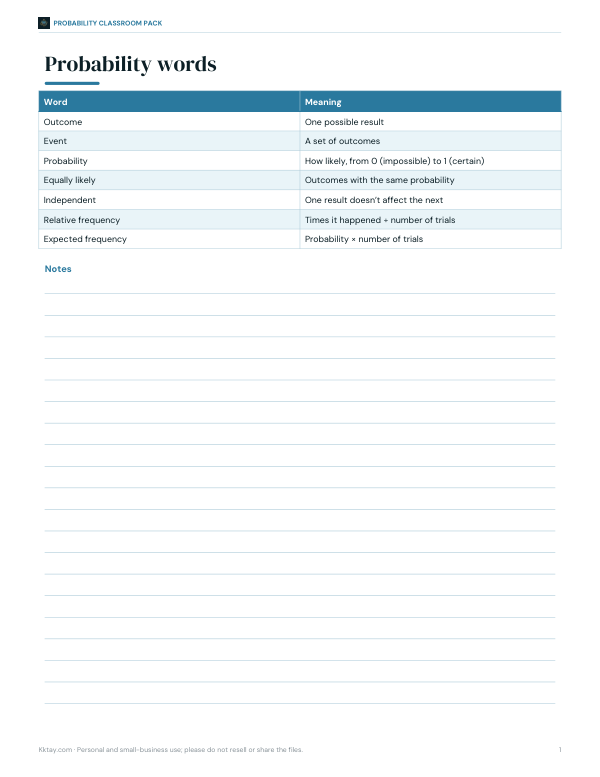
Printable probability activities: a five-outcome experiment worksheet, tally and bar chart templates, a probability vocabulary sheet and a 20-question practice set with answers.
- Experiment worksheet (PDF, DOCX)
- Tally chart (PDF, XLSX)
- Vocabulary (PDF)
- Practice set (PDF, DOCX)
Formats: PDF, DOCX, XLSX. Instant download after payment (link valid 72 hours, up to 5 downloads). AI-assisted: the templates were drafted with AI help and reviewed and laid out before publishing.
$5.00 USD, one-time 4 files · about $1.25 each
- Instant download
- 7-day refund
- Secure checkout by Stripe
7-day money-back guarantee. Full refund within 7 days of purchase, even after you download.
Free sample: Five Outcome Experiment (PDF, 60 KB)
Full refund within 7 days — see the refund policy and license.
Free printables
Single sheets you can print right now, no sign-up. The full pack adds every sheet in one download plus the editable files.
 Printable Probability Practice Set for 1 to 5
How random is it?
Each number comes from crypto.getRandomValues, your browser’s cryptographically secure random number generator — the same source used to create encryption keys. To turn a random 32-bit value into a number from 1 to 5 without bias, the generator uses rejection sampling: it discards the handful of raw values at the very top of the range that would make some numbers slightly more likely than others. Every number from 1 to 5 therefore has exactly the same 20% chance on every pick, independent of previous picks.
Using the generator
- Press “Pick a number” for a single random number between 1 and 5.
- To generate several at once, set “How many” and press “Generate list”.
- Choose “No repeats” to shuffle the numbers 1 to 5 into a random order — useful for taking turns.
- Change From and To for any other range, such as 1–6 for a die or 1–100.
- Watch the tally and chart, or press “Tally 1,000 picks” to see how evenly the numbers come up.
Probability with five outcomes
| Question | Probability |
|---|---|
| Getting a 3 on one pick | 1/5 = 20% |
| Getting an even number (2 or 4) | 2/5 = 40% |
| Two picks both 5 | 1/25 = 4% |
| Two picks the same number | 1/5 = 20% |
| Three picks all different | (5 × 4 × 3)/125 = 48% |
| No 1 in five picks | (4/5)⁵ ≈ 32.8% |
Worked example: checking fairness
Press “Tally 1,000 picks”. Each number should appear about 200 times, but random variation means you might see something like 192, 211, 197, 204 and 196. The chi-square statistic adds up (observed − expected)² ÷ expected for each number — here about 1.1. With four degrees of freedom that gives a p-value around 0.9, meaning a spread like this is entirely normal for a fair generator. Only a very small p-value (below about 0.01) would suggest something odd, and even then it happens about 1 time in 100 by chance.
The streaks myth
People expect random sequences to alternate more than they do. In 20 picks from 1 to 5, the chance that at least one number appears twice in a row is about 97%, and runs of three in a row turn up fairly often. This doesn’t mean the generator is broken — the “gambler’s fallacy” is believing that a number is “due” after it hasn’t appeared for a while. Each pick is independent; the generator has no memory.
Uses for a 1–5 picker
- Choosing one of five options — restaurants, films, chores or questions.
- Deciding the order of five speakers or players (use No repeats).
- Rating prompts and classroom “number of the day” activities.
- Random sampling in small experiments or surveys.
- Games that need a five-sided die.
- Breaking ties fairly.
Random number vs a real die
There is no common physical five-sided die, which is why a random number generator is handy for 1–5. People sometimes roll a six-sided die and re-roll a 6, which is also perfectly fair — it is the same rejection idea the generator uses. Ten-sided dice numbered 0–9 can be used by mapping 0–1 to 1, 2–3 to 2, and so on.
Other ways to pick 1 to 5 fairly
- Write the numbers on five identical slips of paper, fold them and draw one from a hat.
- Roll a six-sided die and roll again on a 6.
- Use playing cards: ace to five of one suit, shuffled well.
- Spin a spinner divided into five equal sectors.
Generating numbers in a spreadsheet or code
In Excel or Google Sheets, =RANDBETWEEN(1,5) returns a random whole number from 1 to 5 each time the sheet recalculates. In Python, random.randint(1, 5) does the same, and secrets.randbelow(5) + 1 uses a cryptographically secure source. In JavaScript, a quick version is Math.floor(Math.random() * 5) + 1, while crypto.getRandomValues with rejection sampling — as this page does — avoids any tiny bias and is suitable when fairness really matters.
Random order for turns
With “No repeats” and five numbers, the generator returns a random permutation — a shuffled order of 1, 2, 3, 4 and 5. There are 5! = 120 possible orders, and each is equally likely. Assign each person a number first, then generate the order: it is a quick and transparent way to decide who presents, plays or chooses first.
Privacy
The numbers are generated on your device. Nothing is sent or stored except the tally in the current page, which disappears when you close it.
Frequently asked questions
How do I pick a random number between 1 and 5?
Press “Pick a number” — each number has a 20% chance.
Is this random number generator truly random?
It uses the browser’s cryptographically secure generator with unbiased selection.
Can I generate numbers without repeats?
Yes, choose No repeats to get a random order of 1 to 5.
Can I change the range?
Yes, set From and To for any whole-number range.
Why did the same number come up twice in a row?
That happens 20% of the time with a fair 1–5 picker.
Is anything stored?
No, everything stays on your device.
How many different orders of 1 to 5 are there?
120 — that is 5 × 4 × 3 × 2 × 1.
What is the chance of picking the same number three times in a row?
1 in 25 (4%) for any number repeating on the next two picks.